
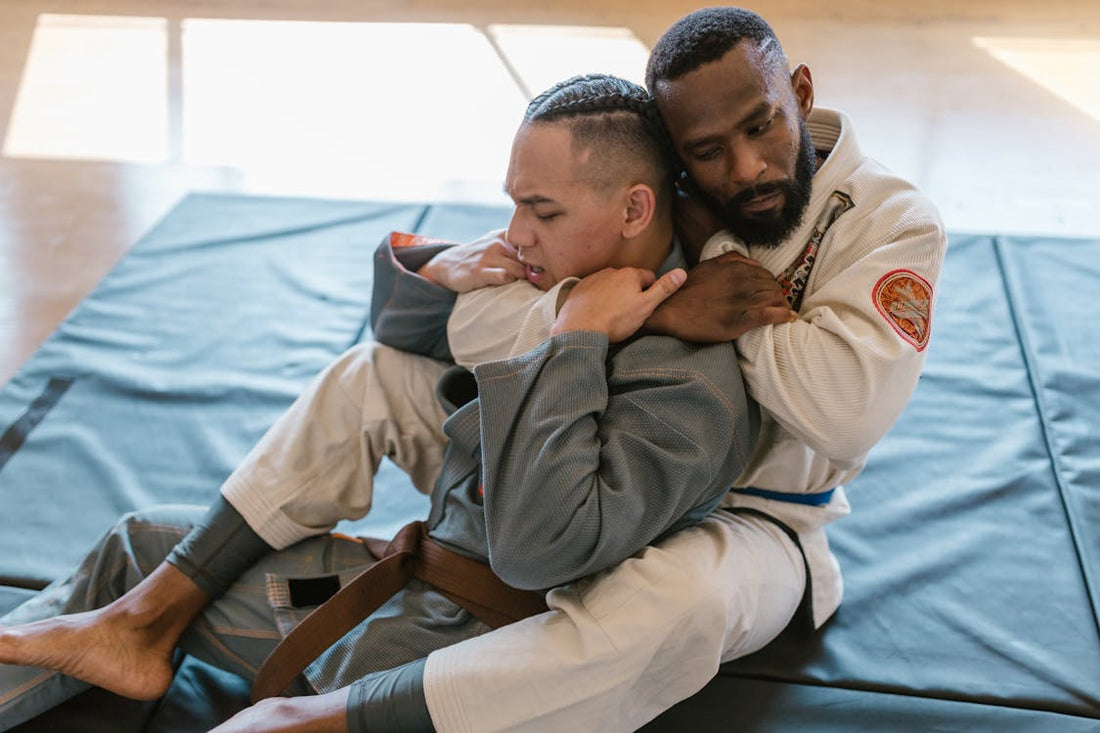
4 ways outside the mat to improve your Jiu-Jitsu
Share
Title: 4 Non-Jiu-Jitsu Things That Will Improve Your Jiu-Jitsu
As much as we'd all love to train Jiu-Jitsu 24/7, it just isn't possible.
For most of us, it's because we have to work (to survive and fund our expensive Jiu-Jitsu passion). Many also have family obligations that demand time (why can't kids raise themselves??). And for 99.9% of us, it's simply that our bodies would break down if we tried. Because let's be honest: Jiu-Jitsu takes a toll on the body. And the older you get, the more you feel it.
Still, we often hear the phrase: “To get better at Jiu-Jitsu, you have to train Jiu-Jitsu.” Logically, we then think that more time on the mat makes us better. Yes, that's true—up to a certain point. Beyond a certain moment, too much training can even be counterproductive.
Believe it or not, your performance on the mat—especially in competition BJJ—also benefits from other activities that have nothing to do with Jiu-Jitsu.
Here are four non-Jitsu-specific “hacks” that can improve your Jiu-Jitsu—even during the busiest schedules.
1. Cross-Training
I know what you're thinking: “If I have time for cross-training, why not just train Jiu-Jitsu?” For one, your Jiu-Jitsu training probably requires far more time than most cross-training activities.
Just the commute to the dojo (10 minutes to over an hour), changing clothes, the actual training (one to two hours), showering, changing again, and the way back can easily take up three hours a day. In comparison, after work you could quickly put on your running shoes and jog for 20 minutes. Or you could roll out a yoga mat in the living room after putting the kids to bed. Maybe you can even squeeze in a quick visit to the gym around the corner.
These activities not only take less time, but also bring immense physical benefits (if you do them regularly). Your improved cardio from running will show in better conditioning on the mat. You'll get less winded and perform better. Your flexibility from yoga helps prevent injuries during inversions and submissions. And stronger muscles protect your joints during intense sparring or difficult positions.
2. Drink More Water (with Salt!)
We often forget that water is the most important element for our body to function properly. Water makes up 60% of our body! We constantly lose water, whether we sweat and train hard or not. If we don't replenish it regularly, we become dehydrated—which negatively affects our physical and mental performance.
Especially if you're active—and even more so if you live in a hot or humid climate—it's important to also consume salt to replace the salt lost through sweating. Salt is crucial for fluid balance, nerve and muscle function, and cognitive performance. But that doesn't mean you should drink tons of isotonic drinks (the sugar in them cancels out the benefits). A pinch of salt in your water is enough.
How much water should you drink? A good guideline is 0.5–1.0 ounces of water per pound of body weight. If you weigh about 70 kg, you should drink roughly 3.5 liters of water per day.
3. Enough Sleep
Jiu-Jitsu is as much mental as it is physical—I probably don't need to tell you that. But I will anyway. One of the best ways to improve your BJJ performance is: MORE SLEEP.
Sleep is essential for storing and processing memories and learned skills, for better decision-making, and emotional health. All of this supports your growth on the mat. If you don't give your body enough sleep, you risk hindering this growth and possibly wasting all the time you invest in training.
4. Another Hobby
Burnout is a real problem in Jiu-Jitsu. This is mainly due to the addictive nature of the sport. We crave training, learning, growth, and mental as well as physical activity. But we neglect ourselves and/or overtrain. Then we get disappointed when we plateau. We believe more training could get us out of the rut, but that only worsens burnout. A vicious cycle.
The best thing you can do—to prevent or cure burnout—is to have another hobby that has nothing to do with Jiu-Jitsu. It can really be anything: chess, pottery, knitting, cooking, taxidermy… whatever. A separate hobby helps balance your time on the mat and prevents guilt. It offers you a different mental—and maybe physical—outlet that stimulates your brain in ways other than Jiu-Jitsu. And if you do get burned out, you have something to retreat to until you return to the mat with joy.
Conclusion
The things you do for yourself outside the mat also pay off for your Jiu-Jitsu performance. Train hard, train smart, train safe.


